What is Stig factor?
ZEN>>Isolation but observation. Visibility in Invisibility.
Why do I need to know this?
ZEN>> Because Top-gear has this. Because this is the ultimate truth (well a step short of if there is one). Because you asked me. And if you think zen doesnt' involve one thinking of Aston martins, you are wrong. It is always about things like Spider vs. Beetle in the parking lot. I like both of them by the way.
Master explain this in simple English to us 'not so crazy nuts'
ZEN>> Now that you have asked. In this world all entities are related. Some call it 'Butterfly effect'. This association is responsible for all joys and sorrows. Now wise men and truth seekers, who have realized this truth wanted to let others escape the miseries offered by this cruel life. They came up with an brilliant suggestion. That speaks of:
1. Association to disassociation
2. The hardships in breaking all bonds to keep a single bond.
Master but I am a simple programmer
ZEN>> Thats what they said when they came to me. They were simple tv program producers. I still remember that as if it were yesterday.
Master, but who said that
ZEN>> The top-gear chaps of course. They were very concerned about the presenters being more popular than the show. There was a bloke called Gerome clarkson who has nasty prejudice against general motors you know. They wanted some thing which is immune to change. So they brought in Stig. You can realise more about him from http://en.wikipedia.org/wiki/The_Stig . You see there was more than one stig but there is only one stig.
Oh, the zen factor. Things may change but the conception is unique. This what decoupling between modules means
ZEN>> Excellent, now meditate more about decoupling between modules and data bases. One can easily say that data bases are similar to modules with a different avatar. The trick is to store the mapping away from the modules. The modules change but the mapping rarely does. Even if it does you can easily adapt the mapping to the discovered truth
Saturday, December 1, 2007


Saturday, November 17, 2007
Autumn in Leeds
Autumn wind in Yorkshire Leeds, cold chill within causes fluttering leaves,
Stands a tree painting tarmac in orange, awaiting the forgotten spring,
She hopes for new life, and the cost she pays is the misery she paints,
A splendid lass baring robes for her new-born, such scene, is it obscene?
Stands a tree painting tarmac in orange, awaiting the forgotten spring,
She hopes for new life, and the cost she pays is the misery she paints,
A splendid lass baring robes for her new-born, such scene, is it obscene?
Thursday, November 8, 2007
Learning languages
This article is an extract from
http://www.fourhourworkweek.com/blog/2007/11/07/how-to-learn-but-not-master-any-language-in-1-hour-plus-a-favor/
http://www.fourhourworkweek.com/blog/2007/11/07/how-to-learn-but-not-master-any-language-in-1-hour-plus-a-favor/
The content copied for ease of lazy few :) Credits to the guy who wrote it
How to Learn (But Not Master) Any Language in 1 Hour (Plus: A Favor)
Filling the Void, Language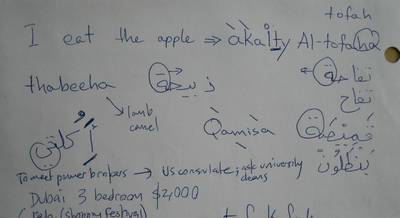
Deconstructing Arabic in 45 Minutes

Conversational Russian in 60 minutes?
This post is by request. How long does it take to learn Chinese or Japanese vs. Spanish or Irish Gaelic? I would argue less than an hour.
Here’s the reasoning…
Before you invest (or waste) hundreds and thousands of hours on a language, you should deconstruct it. During my thesis research at Princeton, which focused on neuroscience and unorthodox acquisition of Japanese by native English speakers, as well as when redesigning curricula for Berlitz, this neglected deconstruction step surfaced as one of the distinguishing habits of the fastest language learners.
So far, I’ve deconstructed Japanese, Mandarin Chinese, Spanish, Italian, Brazilian Portuguese, German, Norwegian, Irish Gaelic, Korean, and perhaps a dozen others. I’m far from perfect in these languages, and I’m terrible at some, but I can converse in quite a few with no problems whatsoever—just ask the MIT students who came up to me last night and spoke in multiple languages.
How is it possible to become conversationally fluent in one of these languages in 2-12 months? It starts with deconstructing them, choosing wisely, and abandoning all but a few of them.
Consider a new language like a new sport.
There are certain physical prerequisites (height is an advantage in basketball), rules (a runner must touch the bases in baseball), and so on that determine if you can become proficient at all, and—if so—how long it will take.
Languages are no different. What are your tools, and how do they fit with the rules of your target?
If you’re a native Japanese speaker, respectively handicapped with a bit more than 20 phonemes in your language, some languages will seem near impossible. Picking a compatible language with similar sounds and word construction (like Spanish) instead of one with a buffet of new sounds you cannot distinguish (like Chinese) could make the difference between having meaningful conversations in 3 months instead of 3 years.
Let’s look at few of the methods I recently used to deconstructed Russian and Arabic to determine if I could reach fluency within a 3-month target time period. Both were done in an hour or less of conversation with native speakers sitting next to me on airplanes.
Six Lines of Gold
Here are a few questions that I apply from the outset. The simple versions come afterwards:
1. Are there new grammatical structures that will postpone fluency? (look at SOV vs. SVO, as well as noun cases)
2. Are there new sounds that will double or quadruple time to fluency? (especially vowels)
3. How similar is it to languages I already understand? What will help and what will interfere? (Will acquisition erase a previous language? Can I borrow structures without fatal interference like Portuguese after Spanish?)
4. All of which answer: How difficult will it be, and how long would it take to become functionally fluent?
It doesn’t take much to answer these questions. All you need are a few sentences translated from English into your target language.
Some of my favorites, with reasons, are below:
The apple is red.
It is John’s apple.
I give John the apple.
We give him the apple.
He gives it to John.
She gives it to him.
These six sentences alone expose much of the language, and quite a few potential deal killers.
First, they help me to see if and how verbs are conjugated based on speaker (both according to gender and number). I’m also able to immediately identify an uber-pain in some languages: placement of indirect objects (John), direct objects (the apple), and their respective pronouns (him, it). I would follow these sentences with a few negations (“I don’t give…”) and different tenses to see if these are expressed as separate words (“bu” in Chinese as negation, for example) or verb changes (“-nai” or “-masen” in Japanese), the latter making a language much harder to crack.
Second, I’m looking at the fundamental sentence structure: is it subject-verb-object (SOV) like English and Chinese (“I eat the apple”), is it subject-object-verb (SOV) like Japanese (“I the apple eat”), or something else? If you’re a native English speaker, SOV will be harder than the familiar SVO, but once you pick one up (Korean grammar is almost identical to Japanese, and German has a lot of verb-at-the-end construction), your brain will be formatted for new SOV languages.
Third, the first three sentences expose if the language has much-dreaded noun cases. What are noun cases? In German, for example, “the” isn’t so simple. It might be der, das, die, dem, den and more depending on whether “the apple” is an object, indirect object, possessed by someone else, etc. Headaches galore. Russian is even worse. This is one of the reasons I continue to put it off.
All the above from just 6-10 sentences! Here are two more:
I must give it to him.
I want to give it to her.
These two are to see if auxiliary verbs exist, or if the end of the each verb changes. A good short-cut to independent learner status, when you no longer need a teacher to improve, is to learn conjugations for “helping” verbs like “to want,” “to need,” “to have to,” “should,” etc. In Spanish and many others, this allows you to express yourself with “I need/want/must/should” + the infinite of any verb. Learning the variations of a half dozen verbs gives you access to all verbs. This doesn’t help when someone else is speaking, but it does help get the training wheels off self-expression as quickly as possible.
If these auxiliaries are expressed as changes in the verb (often the case with Japanese) instead of separate words (Chinese, for example), you are in for a rough time in the beginning.
Sounds and Scripts
I ask my impromptu teacher to write down the translations twice: once in the proper native writing system (also called “script” or “orthography”), and again in English phonetics, or I’ll write down approximations or use IPA.
If possible, I will have them take me through their alphabet, giving me one example word for each consonant and vowel. Look hard for difficult vowels, which will take, in my experience, at least 10 times longer to master than any unfamiliar consonant or combination thereof (”tsu” in Japanese poses few problems, for example). Think Portuguese is just slower Spanish with a few different words? Think again. Spend an hour practicing the “open” vowels of Brazilian Portuguese. I recommend you get some ice for your mouth and throat first.
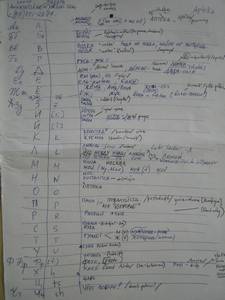
The Russian Phonetic Menu, and…

Reading Real Cyrillic 20 Minutes Later
Going through the characters of a language’s writing system is really only practical for languages that have at least one phonetic writing system of 50 or fewer sounds—Spanish, Russian, and Japanese would all be fine. Chinese fails since tones multiply variations of otherwise simple sounds, and it also fails miserably on phonetic systems. If you go after Mandarin, choose the somewhat uncommon GR over pinyin romanization if at all possible. It’s harder to learn at first, but I’ve never met a pinyin learner with tones even half as accurate as a decent GR user. Long story short, this is because tones are indicated by spelling in GR, not by diacritical marks above the syllables.
In all cases, treat language as sport.
Learn the rules first, determine if it’s worth the investment of time (will you, at best, become mediocre?), then focus on the training. Picking your target is often more important than your method.
[To be continued?]
###
Is this helpful or just too dense? Would you like me to write more about this or other topics? Please let me know in the comments. Here’s something from Harvard Business School to play with in the meantime…
###
Odds and Ends:
Please help me break the Technorati 1000 today!
I’m around 1070 on Technorati’s rankings, and it’s killing me. Can those of you with blogs PULEEEEASE register your blogs with Technorati and find something interesting to link to on this 4HWW blog? It would really be a milestone for me and I’m so close! Just breaking 1000 would be enough. If you can find something to link to in the most popular posts or elsewhere, please do whatever you can in the next 24-36 hours! Thanks so much :)
Wednesday, November 7, 2007
Ratatouille - Any one can cook!
The story is about a rodent hero. The one who resembles more like R2D2 than Keanu reaves. The plot is simple. The hero fulfils his dream!. The dream of savouring food in Gusteaus, a french restaurant. The way the story unfolds brings some childhood memories out. Running around kitchen, doing a shelock holmes with the whole and sole intention of finding the hidden delicacies. Aah, good times weren’t' they.
The more reminiscent words I liked were those of the antagonist Anton Ego voiced by Peter O'tole. Ego relives Gusteau’s words 'Any one can cook'. He rephrases the finer nuance and articulately gives out his criticism during at the climax. Anton declares onerous in a tone that undermines Zen masters and Yoda; that a cook can come from any where and not the superficial interpretation given to the words.
The art of oration put together with some fantastic graphics is something one shouldn’t' miss. This is one fantastic package put forth for audience of all ages.
Tuesday, October 30, 2007
Creative thinkers and Day dreamers
Creative thinking or out of box thinking is normally encouraged in technical and artisitc streams, but discouraged in managerial discipline. http://en.wikipedia.org/wiki/Peter_Principle has a good explanation of this. Creative thinking helps individuals and organisations. People raise the bar even when the results end in a catastrophy. The gains at times may be paltry but the learning is invalueable. Coupled with some pedagogic skills such a learning becomes an asset in times to come. Unfortunately, creative thinking cannot be imbibed. It is inherently psychlogical. The inquisitive nature seen in children when groomed well forms the foundation for this.
So the next time a child asks why he doesnt' have a moustache or where babies come from. Try to be creative enough to answer. Afterall child is the father of man.
Try googling for Gordian Knot, Egg of Columbus for more insights. The structure of Benzene as proposed by kekulle is another outstanding example.
Tuesday, October 23, 2007
'Memory'able Dilema
Dear God, Father of all electronic, electrical, magnetic, optical, semiconductor appliances. Conserver of all software applications built around boolean and binary representation. Help me out of dilema.
Should I opt for an 4 Gb flash drive or a 160 Gb passport hdd or a 500 Gb hdd. Give me the wisdom and guidance.
P.s: At the same time have a look at the Canon S5IS and Sony DSC-H9, so that you can let me make a decison.
Should I opt for an 4 Gb flash drive or a 160 Gb passport hdd or a 500 Gb hdd. Give me the wisdom and guidance.
P.s: At the same time have a look at the Canon S5IS and Sony DSC-H9, so that you can let me make a decison.
Static imports
Himanshu was speaking of static imports in Jdk 5. Not surprisingly, I had something to learn over here too. Jdk 5 has come up with a feature for importing static variables; the fact that the same is applicable to methods and object references was news for me. I never thought of it before. What are the implications? Well like every feature and tool this adds a new destructive angle to the object oriented paradigm. It is better not to teach static imports to beginners. (Hey this is my blog.. don’t' contest).
With access specifiers of type 'public final static' there is no problem at all. Essentially making imported entities read only. But if we have a static object reference or method, the object oriented ness is lost. The static methods themselves are stateless. The seemingly non-object oriented way of accessing methods and references is what concerns me. The static methods themselves are stateless. We have discussed their usage in a earlier blog. The static references and methods are more of a concern to me.
These are most often seen in large scale programming applications. To start of 'Singleton' pattern is one of the most popular patterns built around static reference concept. 'Factory' pattern is another example of using static methods. The fact that
, some crazy guy wants to increase performance sends jitters.(by changing the access specifier to public, use static imports and invoke the functionality, and thus save a 'precious' method call). Do we break the paradigm for the sake of small performance gains?
All said, this adds more emphasis on code reviews and another aspect to the taken care of when carrying out code reviews.
Subscribe to:
Posts (Atom)
Popular Posts
-
I recently had to come with this data-structure, later I found that google collections has a MapMaker which essentially does the same. Post...
-
This is the way I like to handle events. Note the ease with which the MessageSenders and MessageListeners can be "weaved" using ao...
-
There are times when we face the need to marshall and unmarshall java objects. What better than XML for this! Most programmers can write the...
-
Bananas for the code monkey It is always a good idea to prevent users from doing unwarranted things. Thats the whole idea of client side val...
-
Event bus is a rather simple notion, that is of great aid. Think of a telephone network; to communicate between two ends, one would require ...

Subscribe To


 Posts
All Comments